Work arrives from every direction — tenant calls, client portals, site managers, and ad hoc emails — but completion and reporting often depend on whoever remembers to update the spreadsheet or send the follow-up message. Whether you maintain HVAC systems across a portfolio of commercial buildings, respond to reactive callouts for housing associations, or run a multi-site engineering team, the quality of your maintenance request process directly affects client satisfaction, SLA compliance, and operational margin.
This guide outlines a practical approach to improving facilities maintenance workflows — from request intake through engineer updates to client visibility — without assuming you need to replace your entire tech stack on day one. For delivery support, see our business process optimisation service.
Reactive vs planned maintenance — and why workflow matters
Most FM operations handle two types of work: reactive maintenance (breakdowns, tenant complaints, urgent callouts) and planned maintenance (PPM schedules, statutory inspections, seasonal servicing). Both need a clear workflow, but they fail in different ways. Reactive jobs demand fast triage and visible status; planned work needs scheduling, asset tracking, and proof of completion.
Without a consistent field service workflow, reactive work always wins. Engineers drop planned visits to chase emergencies, coordinators lose track of open jobs, and clients receive incomplete updates. A defined maintenance request process — with shared statuses and ownership at each stage — prevents the reactive backlog from swallowing everything else.
The goal is not to eliminate reactive work; it is to stop it from breaking the system that planned maintenance depends on. When every job follows the same path from logged to reported, coordinators can see capacity, prioritise correctly, and give clients accurate answers without checking three different channels.
Where work orders get lost
The most common failure points in FM operations are familiar because each channel feels convenient in the moment:
- Phone calls — logged on paper, scribbled on a whiteboard, or not recorded at all
- Email — requests buried in inboxes, forwarded without context, or never reaching the assigned engineer
- WhatsApp groups — urgent messages scroll past unseen; no audit trail or searchable history
- Spreadsheets — updated inconsistently, with multiple versions circulating across teams
- No single status — nobody can answer "where is this job?" without checking several places first
Together these create blind spots. A client asks what is happening with job 447, and three people check three different places before anyone can respond — if they respond at all. These are classic workflow bottlenecks; our guide to process bottleneck analysis explains how to identify and prioritise fixes like these.
The root cause is rarely lack of effort. Coordinators work hard to keep things moving. The problem is that effort is spent reconstructing status rather than advancing work.
A minimum viable maintenance workflow
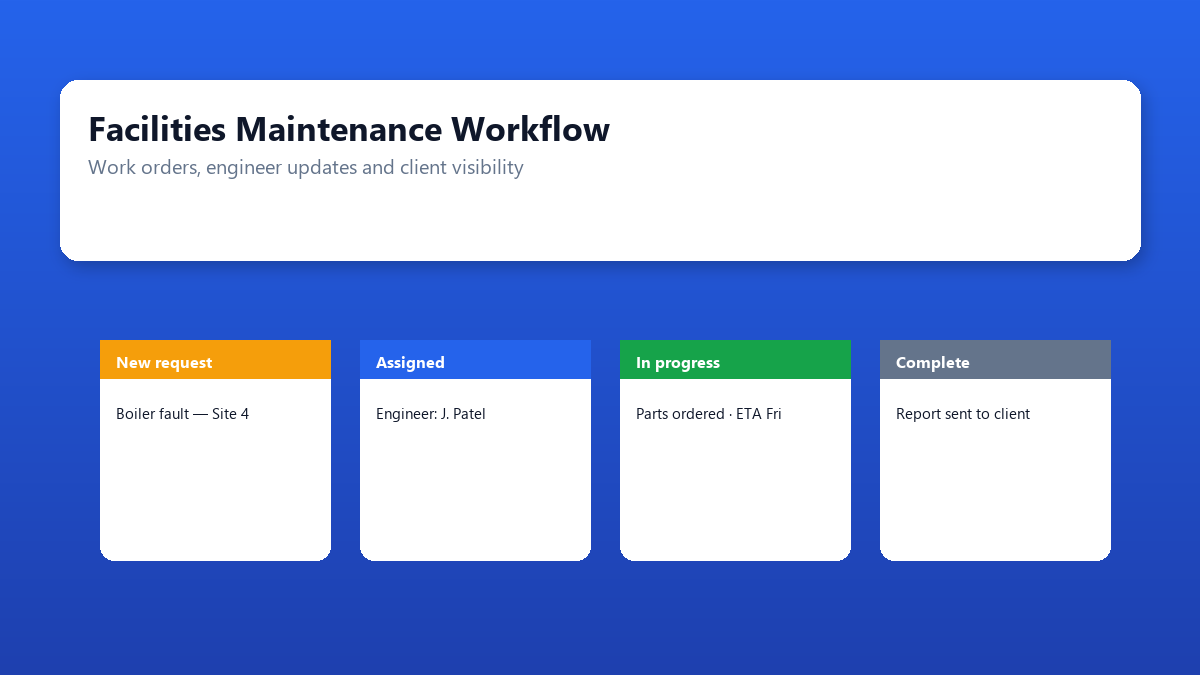
You do not need enterprise FM software to start improving. A minimum viable workflow covers five states that every job passes through:
- Request logged — every job enters one system with date, location, description, and priority
- Assigned — named engineer or team, with an expected response window
- In progress — engineer has acknowledged and is on site or en route
- Complete — work finished, notes and evidence captured at the point of completion
- Reported — client or contract manager notified; job closed in reporting
This simple model gives coordinators, engineers, and clients the same picture. It works whether the tool is a shared spreadsheet with strict rules, a lightweight web app, or a full CAFM platform — what matters is that everyone uses one path and one set of statuses.
Resist the temptation to add ten intermediate states on day one. Five clear states that people actually update beat fifteen granular statuses that nobody maintains. Refine the model once adoption is solid.
What clients and internal teams need to see
Clients and internal teams need different views of the same underlying data, but both depend on structured capture at the point of work:
- SLA status — is this job within contract response time? Has the clock started?
- Photos — before-and-after evidence for disputes, audits, and quality assurance
- Parts used — for client recharge, stock planning, and cost tracking
- Engineer notes — what was done, what remains, and whether follow-up is required
Without this information captured when the engineer completes the job, reporting becomes reconstruction. Coordinators chase engineers days later for details they barely remember, and clients lose confidence in the data they receive.
Mobile-friendly forms or a simple field app beat email attachments scattered across inboxes. The best capture tools take under two minutes to complete on site — if they take longer, engineers will skip them and revert to WhatsApp.
Reporting for FM contracts
FM contracts live or die on reporting. Clients expect regular summaries covering open jobs by site and age, response and completion times against SLA, repeat issues at the same location, and the split between planned and reactive work.
Manual reporting from spreadsheets takes hours every week and is always out of date by the time it reaches the client. Coordinators become report builders instead of coordinators. Repeat-issue analysis — spotting a failing asset before the third callout — rarely happens because nobody has time to cross-reference job history.
Automating report generation from a single workflow database, even a lightweight custom tool, frees coordinators for actual coordination. Dashboards that pull live data beat monthly PDFs compiled by hand. For teams ready to connect workflow data with finance, stock, or client portals, our integration and automation service covers the technical path from isolated spreadsheets to connected systems.
Phased improvement without replacing everything
Workflow improvement does not require ripping out your entire tech stack at once. A phased approach reduces risk and builds adoption:
- Phase 1 — Single intake and status model — one place to log jobs, one set of statuses everyone uses
- Phase 2 — Engineer mobile updates — status changes and photo capture from the field, not back at the office
- Phase 3 — Client visibility — portal access or automated status notifications so clients stop calling for updates
- Phase 4 — Integration — connect workflow data to finance, stock management, or existing CAFM systems
Each phase delivers value on its own. Teams that skip straight to Phase 4 often fail because nobody adopted the basics first. Before automating anything, document how work actually flows today — our article on mapping processes before automation explains why this step matters.
Involve coordinators and senior engineers in designing each phase. They know where the real friction is, and their buy-in determines whether a new workflow sticks or gets worked around within a fortnight.
Conclusion
Facilities maintenance workflow improvement is less about buying the biggest platform and more about establishing one reliable path from request to reported completion. Start with visibility — a single intake channel and shared statuses — then add structured field capture, client reporting, and integrations as adoption grows.
Teams that get this right spend less time chasing status and more time delivering the maintenance their clients actually pay for. The tools can be simple; the discipline of using them consistently is what transforms operations.
Work orders stuck in email and spreadsheets?
We help FM contractors and field service teams design maintenance workflows, build lightweight tools, and connect reporting without disrupting day-to-day operations.