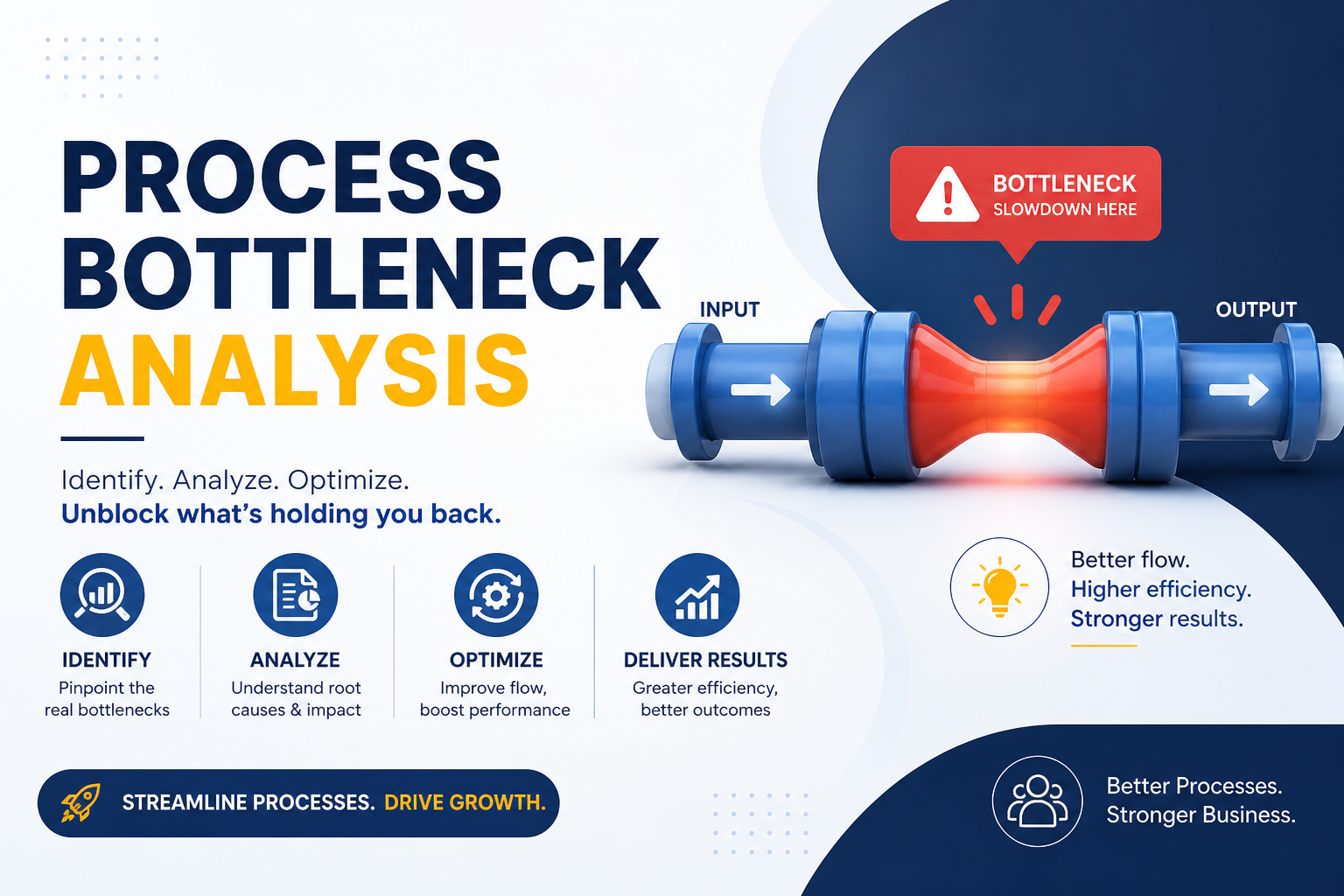
Bottleneck analysis is the foundation of effective process improvement. Without it, teams chase symptoms — faster email responses, extra headcount, another spreadsheet — while the real constraint remains untouched. A structured approach reveals where work queues up, why delays compound, and which interventions will unlock capacity across the entire workflow.
This guide walks through a practical method you can apply without specialist tooling. For delivery support, see our business process optimisation service, and read our article on mapping processes before automation to establish the baseline documentation this analysis depends on.
What counts as a bottleneck?
In operational terms, a bottleneck is any step in a process that limits the rate at which work can flow through the system. If every other stage could handle twice the volume but one step cannot, that step governs overall throughput — regardless of how efficient everything else appears.
Bottlenecks take several forms:
- Capacity constraints — a team, system, or individual that cannot keep pace with incoming demand
- Approval gates — sign-off steps where work sits waiting for a decision-maker who is unavailable or overloaded
- Handoff delays — transitions between departments where ownership is unclear or information is incomplete
- System limitations — software that requires manual workarounds, lacks integration, or performs slowly under load
- Skill dependencies — tasks that only one or two people can perform, creating a single point of failure
- Policy or compliance steps — necessary checks that add time but are not designed for efficiency
Not every slow step is a bottleneck. A step that takes a long time but never queues work is a cost centre, not a constraint. Focus on where work accumulates.
Gathering evidence before you intervene
Effective analysis starts with observation, not assumptions. Managers often believe they know where delays occur, but front-line data frequently tells a different story. Collect evidence from three sources:
- Process maps — document the current-state workflow with timings, handoffs, and decision points. If you do not have maps yet, start there before deep analysis.
- Queue data — how many items are waiting at each stage, and for how long? Ticket backlogs, inbox counts, and WIP limits reveal constraint points quickly.
- Cycle time breakdown — measure end-to-end duration and segment it by stage. Often 80% of total cycle time sits in 20% of steps — frequently waiting, not working.
Shadow staff for a day if metrics are unavailable. Watch where they switch context, chase information, or re-enter data. These friction points often indicate upstream bottlenecks or missing integration.
Techniques for identifying bottlenecks
Several established methods complement each other:
- Value stream mapping — plot each step, classify it as value-add, necessary non-value-add, or waste, and annotate cycle times and wait times. The widest gap between steps usually marks the constraint.
- Theory of Constraints (TOC) — identify the single step limiting system output, exploit it (ensure it never sits idle), subordinate other steps to its pace, elevate capacity if needed, then repeat as the constraint moves.
- Five Whys — when work queues at a stage, ask why repeatedly until you reach a root cause rather than a symptom. "Approvals are slow" becomes "approvers lack context" becomes "requests arrive without required attachments."
- Pareto analysis — rank delay causes by frequency or impact. Fixing the top two or three reasons often resolves most of the queue.
You do not need all four. Pick the method that fits your team's familiarity and the complexity of the process under review.
Measuring impact to prioritise fixes
Once you have a list of bottlenecks, resist fixing everything at once. Prioritise using a simple impact-effort matrix weighted by business outcomes:
- Throughput impact — how much additional volume would resolving this bottleneck unlock?
- Customer or SLA impact — does this delay breach service commitments or damage client relationships?
- Cost of delay — what does each day of backlog cost in staff time, penalties, or lost revenue?
- Effort to resolve — can this be fixed with a policy change in a week, or does it require a six-month system project?
- Risk of inaction — will this bottleneck worsen as volume grows, or is it stable at current scale?
Score each candidate bottleneck against these criteria. High-impact, low-effort items form your quick wins. High-impact, high-effort items belong in a phased roadmap. Low-impact items can wait — or be eliminated if the step itself adds no value.
Common mistakes in bottleneck analysis
Teams often fall into predictable traps:
- Optimising non-constraints — making a fast step faster does not improve overall throughput if the bottleneck remains
- Adding capacity everywhere — hiring across the board is expensive and may not address the actual constraint
- Automating the bottleneck without redesign — encoding a broken process into software accelerates the wrong workflow
- Ignoring variability — average cycle times hide spikes. A step that is usually fast but occasionally blocks for days may be your real problem
- Fixing once and moving on — when you elevate one constraint, another emerges. Bottleneck analysis is iterative, not a one-off exercise
From analysis to action
Translate findings into a prioritised improvement plan with clear owners and success metrics. For each selected bottleneck, define:
- The current-state metric (queue depth, average wait time, cycle time contribution)
- The target improvement and deadline
- The intervention type — process redesign, policy change, training, tooling, or integration
- How you will verify the fix worked without creating a new constraint elsewhere
Review progress fortnightly during active improvement cycles. Re-run the analysis quarterly or whenever volume, team structure, or systems change materially.
Conclusion
Bottleneck analysis turns vague frustration about "things taking too long" into a prioritised, evidence-based improvement agenda. Map the process, measure where work waits, apply a structured identification method, and rank fixes by business impact. Fix the constraint first — then look for the next one. That discipline delivers compounding gains that scattered improvement efforts rarely match.
Ready to find your real bottlenecks?
We analyse workflows, quantify constraints, and deliver process improvements that unlock capacity — not just shuffle the queue.