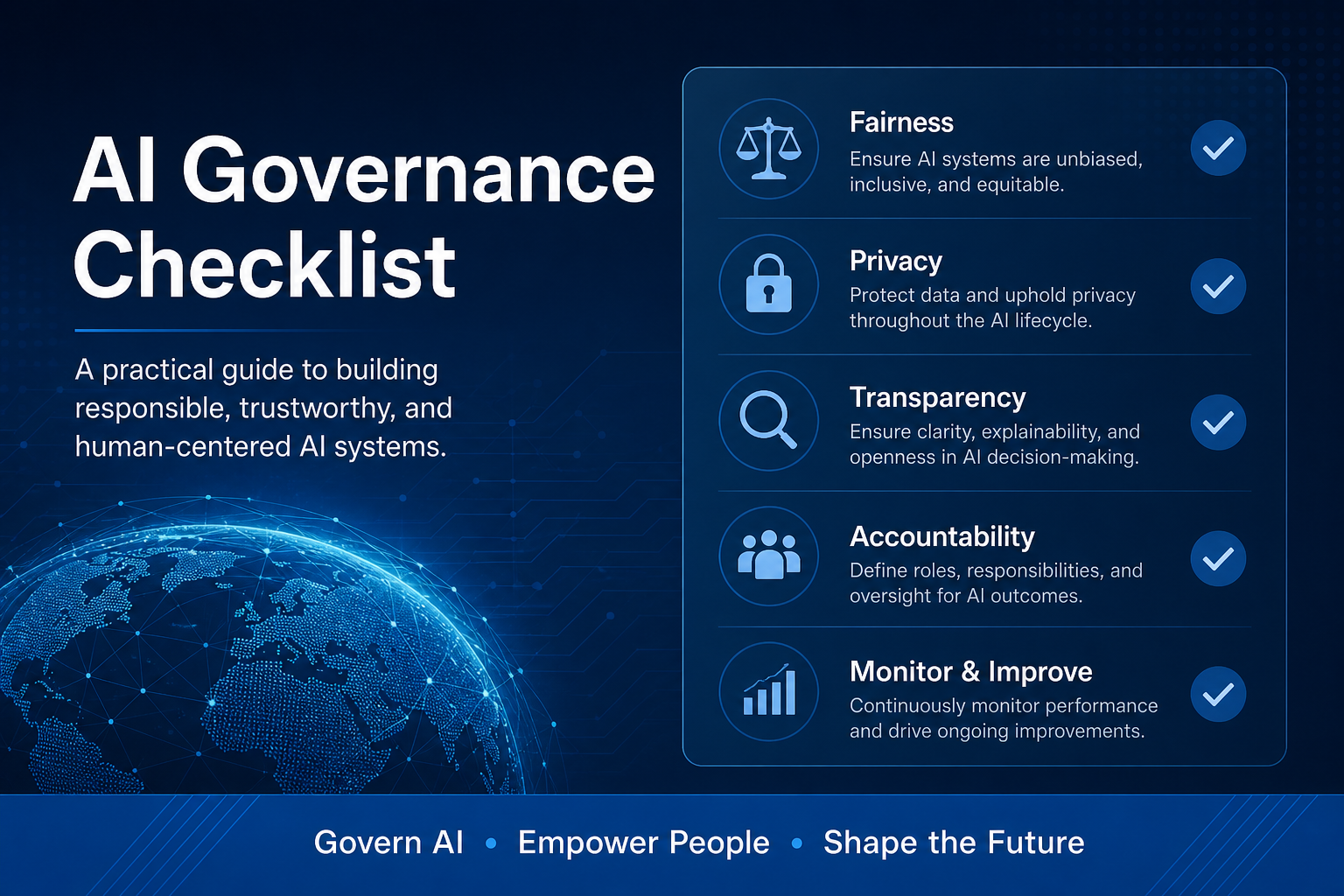
Governance does not mean slowing innovation to a crawl. It means defining clear guardrails so teams know what they can experiment with, what needs approval, and how to handle incidents when something goes wrong. This checklist covers the areas most organisations overlook until a problem surfaces.
For help implementing AI responsibly in your workflows, see our AI enablement service. If you are evaluating copilots for customer-facing teams, our guide on choosing an AI copilot for sales and support complements this governance framework.
1. Define scope and acceptable use
Before deploying any AI tool, document what it is allowed to do — and what it is not.
- Which use cases are approved (e.g. draft generation, summarisation, classification)?
- Which are prohibited (e.g. automated credit decisions, medical advice, legal conclusions)?
- Does output require human review before it reaches customers or regulators?
- Are employees permitted to use personal AI accounts for work data?
Publish an acceptable use policy that is short enough for people to read and specific enough to answer common questions. Review it quarterly as tools and regulations evolve.
2. Classify and protect data
AI systems consume data — often more than teams realise. Map what data each tool accesses and classify it before deployment.
- Public — safe for general model training or prompts
- Internal — business data that should not leave your tenant
- Confidential — customer PII, financial records, health data
- Restricted — credentials, trade secrets, regulated data
Checklist items:
- Data processing agreements in place with AI vendors
- Opt-out of model training confirmed for enterprise tiers
- Prompt logging policies defined — what is stored, for how long, who can access
- Redaction or anonymisation applied before data enters external models
- GDPR and UK Data Protection Act implications assessed for each use case
3. Evaluate vendor and model risk
Whether you use OpenAI, Anthropic, Google, or a niche vertical model, treat the vendor as a critical supplier.
- Review SOC 2, ISO 27001, or equivalent certifications
- Understand data residency — where prompts and outputs are processed and stored
- Assess model update policies — will behaviour change without notice?
- Define fallback plans if the vendor changes pricing, terms, or availability
- Document model version and configuration for each production use case
For high-stakes applications, run periodic evaluations against a fixed test set to detect model drift or regression after vendor updates.
4. Implement human oversight
AI should augment human judgement, not replace accountability — especially in customer-facing or regulated contexts.
- Define which outputs require human approval before action
- Train users to verify AI-generated content, not copy it blindly
- Establish escalation paths for incorrect, harmful, or biased outputs
- Log human overrides to improve prompts and identify systemic issues
- Assign named owners for each AI-enabled workflow
5. Monitor quality, bias, and safety
Deploying AI is not a set-and-forget exercise. Build lightweight monitoring from day one.
- Track accuracy or user satisfaction metrics for AI-assisted tasks
- Sample outputs regularly for factual errors, tone issues, and bias
- Monitor for prompt injection and adversarial inputs in user-facing tools
- Set alerting for anomalous usage — volume spikes, unusual data access patterns
- Conduct quarterly reviews with business and legal stakeholders
6. Manage shadow AI
Employees will use ChatGPT, Copilot, and other tools regardless of policy — unless you give them approved alternatives that work as well or better.
- Provide enterprise-licensed AI tools with appropriate data controls
- Block or monitor unsanctioned tools on corporate devices where policy requires
- Run awareness sessions — not just compliance training — on safe AI use
- Create a simple intake process for teams wanting to pilot new AI tools
7. Document and audit
Regulators and customers increasingly ask how AI is used. Maintain an AI register — a living inventory of deployed AI systems.
For each entry, record:
- Purpose and business owner
- Model/vendor and version
- Data categories processed
- Risk classification (low, medium, high)
- Controls applied and last review date
This register becomes your single source of truth for audits, DPIAs, and board reporting.
Conclusion
AI governance is not a one-off compliance exercise — it is an operational discipline that runs alongside deployment. Start with acceptable use and data classification, add vendor oversight and human review, then build monitoring and documentation as usage scales. Organisations that get this right can adopt AI confidently, while those that skip governance discover the gaps only after an incident.
Deploying AI in your organisation?
We help businesses implement AI tools with practical governance, secure integrations, and workflows that deliver measurable value.