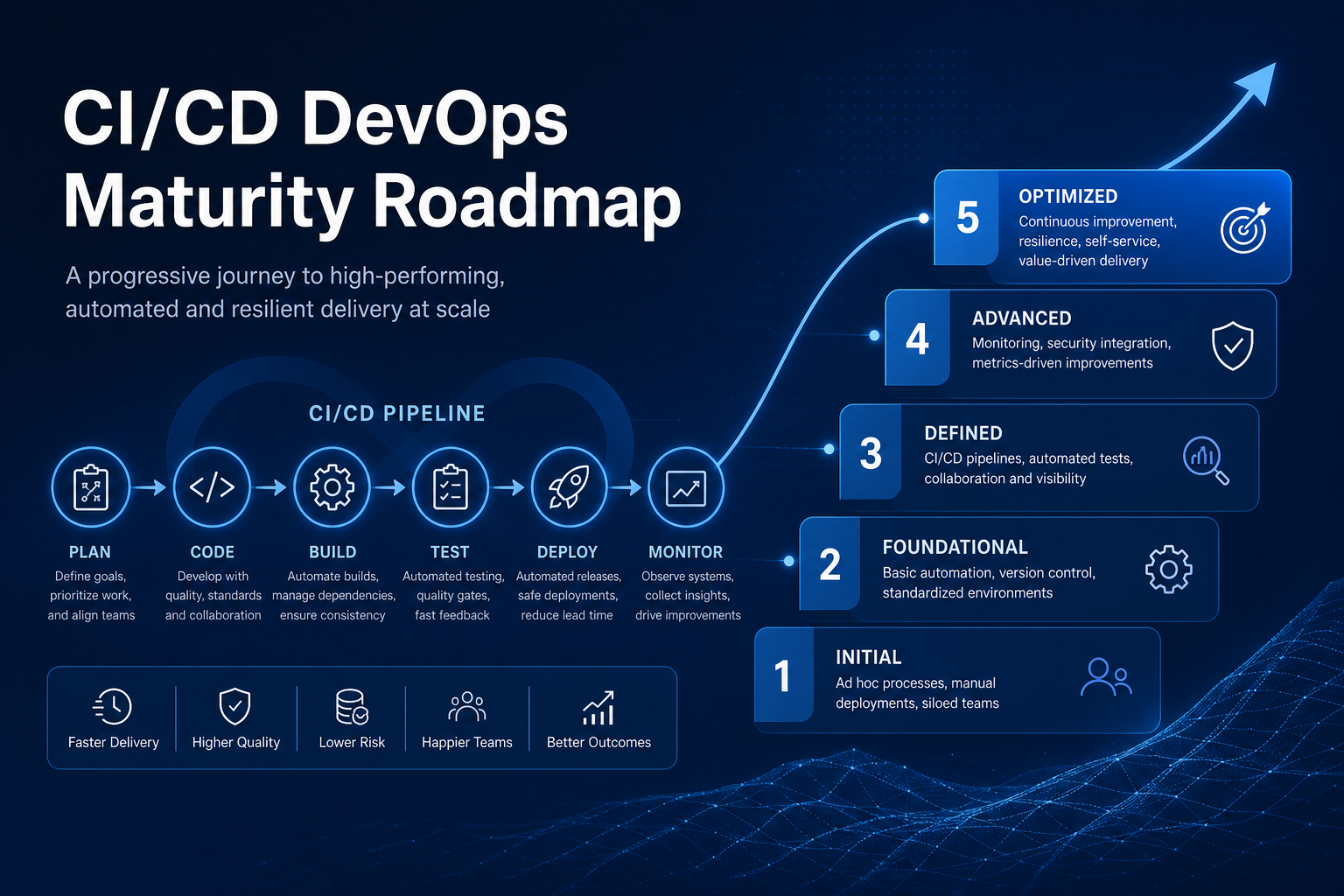
DevOps maturity is not about adopting every tool on the market. It is about reducing the friction between writing code and running it safely in production — and doing so incrementally, without stopping feature delivery.
This roadmap outlines five maturity stages most organisations pass through, with practical milestones at each level. For hands-on help building pipelines and cloud foundations, see our cloud and DevOps enablement service.
Stage 1: Manual and reactive
At the lowest maturity level, deployments are manual, environments differ from each other, and releases are infrequent and stressful. Testing is mostly manual. Rollbacks require someone to SSH into a server or restore from backup.
Typical symptoms:
- Deployments documented in wikis but not consistently followed
- "Works on my machine" is a common phrase
- No staging environment, or staging that does not mirror production
- Incidents discovered by customers, not monitoring
First moves: Version control for all application code and infrastructure config. A single documented deployment runbook. One staging environment that matches production topology. Basic uptime monitoring with alerting.
Stage 2: Basic automation
Teams introduce continuous integration — automated builds and unit tests triggered on every commit. Deployments may still be manual, but the build artefact is consistent and reproducible.
Milestones for this stage:
- CI pipeline running on every pull request (build, lint, unit tests)
- Branch protection requiring passing checks before merge
- Containerised or packaged deployments replacing ad hoc file copies
- Secrets managed outside source code (vault, cloud secret manager)
- Infrastructure defined as code for at least staging and production
Do not skip this stage to chase full continuous deployment. Reliable CI with manual promotion to production is a solid foundation that many mature organisations still use for critical systems.
Stage 3: Continuous delivery
At this stage, every merge to main produces a deployable artefact. Releases to staging are automated. Production deployment requires approval but executes via pipeline — not manual steps.
Key capabilities:
- Automated integration and end-to-end tests in the pipeline
- Environment promotion: dev → staging → production with consistent config
- Database migration scripts run as part of deployment
- Feature flags to decouple deployment from release
- Deployment frequency measured — aim for at least weekly to staging, bi-weekly to production
Measure lead time for changes and change failure rate using DORA metrics. Even rough benchmarks help justify further investment to leadership.
Stage 4: Continuous deployment with guardrails
Continuous deployment means production releases happen automatically when the pipeline passes — no manual approval gate. This requires high confidence in your test suite, observability, and rollback mechanisms.
Prerequisites before attempting this:
- Comprehensive automated test coverage including integration tests
- Canary or blue-green deployment strategy with automated rollback
- Real-time observability — metrics, logs, traces with SLO-based alerting
- Blast radius limits — deploy to a subset of users or services first
- Incident response runbooks tested and on-call rotation in place
Not every application needs continuous deployment on day one. Start with lower-risk internal tools or stateless microservices, then expand as confidence grows.
Stage 5: Platform engineering and self-service
At the highest maturity level, development teams deploy independently through an internal developer platform (IDP). The platform team provides golden paths — pre-configured templates for services, databases, monitoring, and CI/CD — so product teams focus on features, not infrastructure plumbing.
- Self-service environment provisioning
- Standardised service templates with security and observability baked in
- Cost visibility per team or service
- Automated compliance checks in the pipeline (security scanning, licence audits)
- Developer experience metrics tracked alongside DORA metrics
How to advance without boiling the ocean
Jumping from Stage 1 to Stage 4 in one programme usually fails. Instead:
- Pick one application as a reference implementation — ideally medium complexity, actively developed, and owned by a team willing to collaborate
- Fix the biggest pain point first — if deployments take four hours, automate that before adding canary releases
- Invest in observability early — you cannot improve what you cannot measure
- Align with modernisation work — if you are migrating legacy systems, embed CI/CD in each phase rather than bolting it on at the end. See our guide on phased legacy modernisation for how delivery practices and architecture evolve together
- Document and socialise wins — faster releases and fewer incidents are compelling evidence for the next investment
Conclusion
DevOps maturity is a journey measured in reduced lead time, lower change failure rates, and less firefighting — not in tool count. Start where you are, automate the painful manual steps first, and advance one stage at a time. The organisations that sustain high maturity treat delivery infrastructure as a product, not a one-off project.
Ready to improve your delivery pipeline?
We help engineering teams build CI/CD pipelines, cloud infrastructure, and DevOps practices that scale with the business.