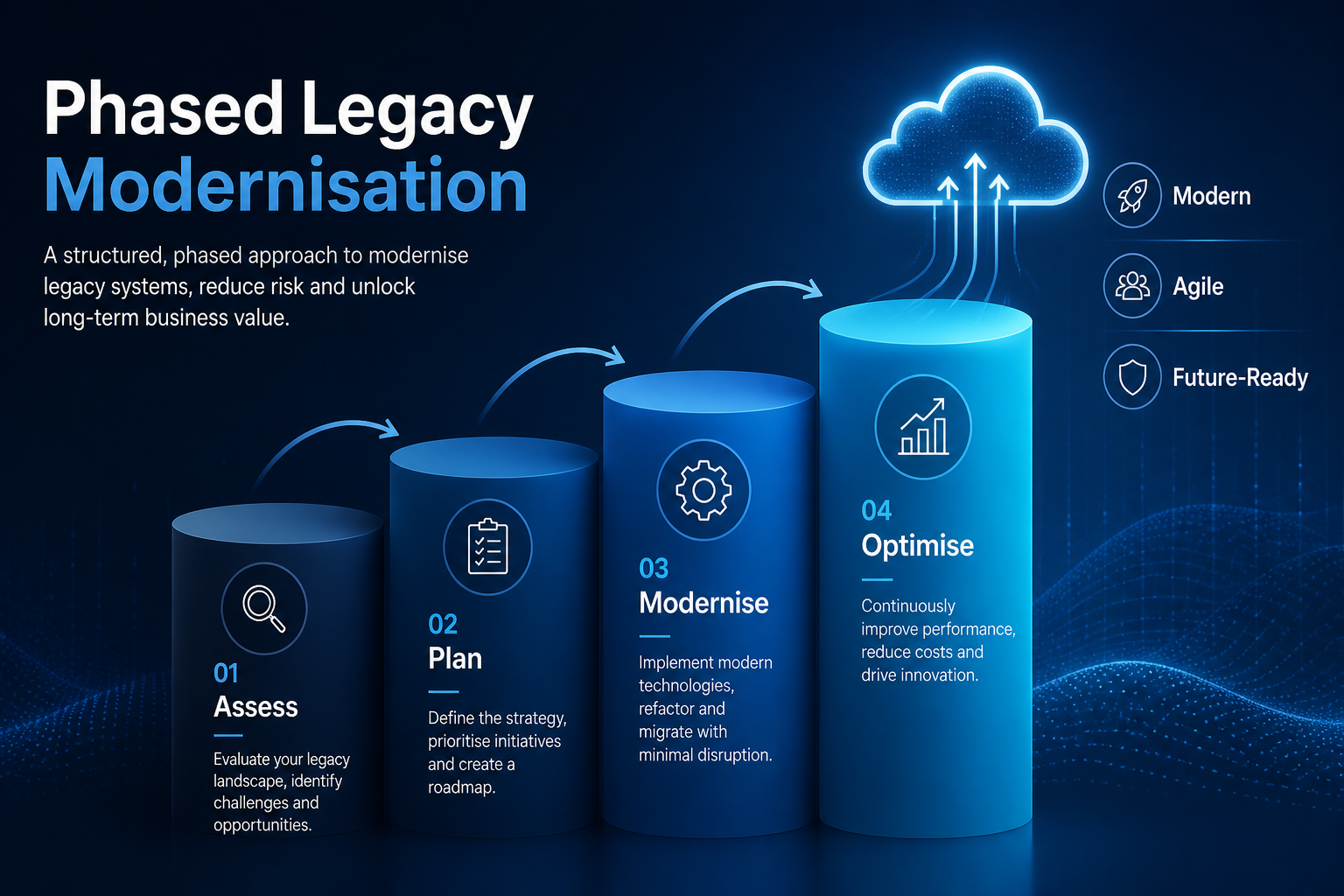
Phased upgrade strategy: core principles
Big-bang replacements rarely go to plan. Budgets overrun, timelines slip, and business stakeholders lose confidence long before the new platform goes live. A phased upgrade strategy — incremental modernisation or the strangler fig pattern — trades the illusion of a clean cutover for steady, measurable progress.
This guide outlines how technical leaders can structure a phased modernisation programme that balances business continuity with genuine architectural improvement. For hands-on delivery support, see our legacy system modernisation service.
Why phased beats big-bang
Legacy systems are rarely monoliths in name only. They carry years of embedded business rules, undocumented workflows, and integration dependencies that only surface under pressure. Attempting to replicate everything before switching over concentrates risk into a single go-live event.
Phased modernisation spreads that risk across multiple releases. Each phase delivers something the business can use, validate, and learn from. You also gain the option to pause, reprioritise, or adjust scope based on real feedback rather than assumptions made at the start of a three-year programme.
- Lower delivery risk — smaller changes are easier to test, roll back, and explain
- Faster time to value — users see improvements within months, not years
- Budget flexibility — funding can be released in tranches tied to outcomes
- Knowledge retention — teams learn the domain as they migrate, reducing dependency on a few experts
Step 1: Assess what you actually have
Before choosing a migration pattern, you need an honest inventory. This is not a spreadsheet of servers — it is a map of business capabilities, data flows, and integration touchpoints.
Focus your assessment on:
- Business criticality — which functions would halt revenue or compliance if they failed?
- Change frequency — systems that change often are better candidates for early replacement
- Technical constraints — unsupported runtimes, missing documentation, single points of failure
- Integration density — how many upstream and downstream systems depend on this component?
- Data quality and ownership — who owns the golden record, and is it trustworthy?
Our work on a financial services legacy modernisation started with exactly this kind of structured assessment, which revealed that two peripheral modules — not the core ledger — were the highest-value first targets.
Step 2: Choose your modernisation pattern
Not every component needs the same treatment. Match the pattern to the problem:
- Rehost (lift and shift) — move to modern infrastructure with minimal code change; good for stable, low-change workloads
- Replatform — move to managed services (e.g. container platform, managed database) with minor adjustments
- Refactor — restructure code within the same runtime to improve maintainability
- Replace — swap with a new build or SaaS product for well-understood, commodity functions
- Strangler fig — route traffic incrementally from old to new components behind a facade or API gateway
Most successful programmes combine patterns. You might rehost a stable reporting engine while strangler-replacing the customer-facing workflow module that changes every quarter.
Step 3: Sequence phases by value and feasibility
Prioritisation is where many programmes stall. Use a simple matrix: plot each component by business value (high to low) against migration complexity (easy to hard). Start with high-value, lower-complexity items to build momentum and credibility.
A practical sequencing rule: migrate at the edges first. Customer portals, reporting layers, and API facades often sit on top of stable cores. Replacing or modernising these surfaces delivers visible improvement without touching the riskiest internals until you have more confidence and tooling in place.
Define clear exit criteria for each phase before you start:
- Functional parity for the scoped use cases
- Performance benchmarks met under production load
- Rollback plan tested and documented
- Operations team trained and runbooks updated
- Legacy component decommissioned or marked read-only
Step 4: Manage the dual-running period
Dual running — where old and new systems operate in parallel — is unavoidable in phased programmes. The goal is to keep it short and controlled.
Invest early in:
- Data synchronisation — event-driven replication or CDC pipelines to keep both sides consistent
- Feature flags and routing — direct specific user groups or transactions to the new path
- Observability — unified logging and tracing across old and new so you can compare behaviour
- Cutover playbooks — step-by-step procedures with named owners and communication templates
Set a hard deadline for dual running on each component. Without one, teams tolerate parallel systems indefinitely, doubling operational cost and confusion.
Step 5: Govern for the long term
Modernisation is not a project with an end date — it is a capability. Establish a lightweight governance rhythm: monthly steering reviews, quarterly architecture checkpoints, and a living roadmap that business stakeholders can read without a technical glossary.
Track leading indicators, not just delivery milestones:
- Mean time to deploy for modernised components
- Incident rate before and after each phase
- Percentage of traffic on the new platform
- Remaining legacy components with decommission dates
When the programme ends — or pauses — you should be able to point to measurable improvements in reliability, speed of change, or operational cost, not just a list of migrated modules.
Conclusion
Phased legacy modernisation is less glamorous than a greenfield rewrite, but it is how most enterprises actually succeed. Start with an honest assessment, pick the right pattern for each component, sequence by value, manage dual running tightly, and govern for continuity. The organisations that get this right treat modernisation as a series of business outcomes, not a single technical event.
Planning a legacy modernisation programme?
We help organisations assess legacy estates, define phased roadmaps, and deliver modernisation without disrupting day-to-day operations.