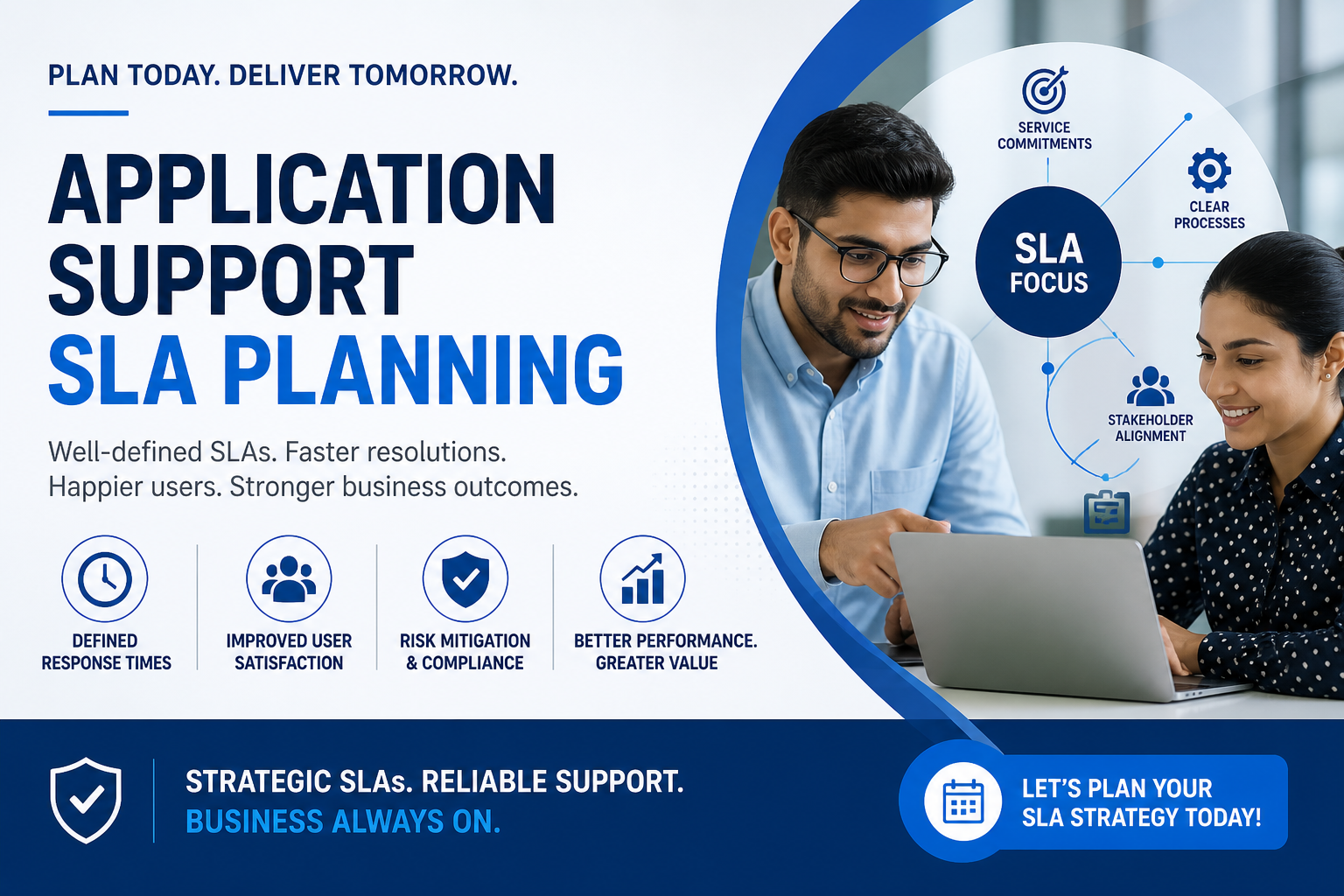
Too many organisations either copy SLAs from a template without adapting them, or define aggressive targets that the team cannot consistently meet. Both approaches erode trust. The goal is an SLA framework that reflects business priorities, matches team capacity, and improves over time with data.
This guide covers how to structure application support SLAs for internal or vendor-delivered support. For ongoing support delivery, see our application support and continuous improvement service.
Start with business impact, not ticket types
SLAs should be driven by the impact of an issue on the business — not by how the ticket was submitted or which application is affected. Define severity tiers based on consequences:
- P1 — Critical: Core business function unavailable; revenue, compliance, or safety at risk; no workaround
- P2 — High: Major function degraded; significant user group affected; workaround exists but is costly
- P3 — Medium: Partial impact; limited user group; workaround available
- P4 — Low: Minor issue, cosmetic defect, or enhancement request; no operational impact
Write clear examples for each tier specific to your applications. Ambiguity at classification time is the most common cause of SLA breaches and user frustration.
Define the right metrics
Most SLA frameworks track two distinct measures:
- Response time — how quickly the support team acknowledges and begins working on the issue
- Resolution time — how long until the issue is fixed or a permanent workaround is in place
Example targets for a business-hours support model:
- P1: 30-minute response, 4-hour resolution target
- P2: 2-hour response, 8-hour resolution target
- P3: 8-hour response, 3-business-day resolution target
- P4: 2-business-day response, scheduled into sprint or backlog
Adjust these based on your coverage hours, team size, and application criticality. An SLA that promises 24/7 P1 resolution requires on-call staffing — build that into the cost model before committing.
Cover support hours and escalation
SLAs must specify when the clock runs:
- Business hours — e.g. Mon–Fri 08:00–18:00 GMT, excluding UK bank holidays
- Extended or 24/7 — for critical production systems; define on-call rotation and compensation
- Pause conditions — when waiting on the user for information, third-party vendor response, or scheduled maintenance
Define escalation paths explicitly:
- Level 1 → Level 2 after initial triage (typically within the response window)
- Level 2 → Level 3 / development team for code-level fixes
- Management escalation if SLA breach is imminent or customer impact is widening
Separate incidents from requests
Incidents (something is broken) and service requests (something new is needed) have different urgency profiles and should not compete for the same SLA targets.
- Incidents — measured by response and resolution time against severity tiers
- Service requests — measured by fulfilment time or backlog age; typically P3/P4 priority
- Changes — scheduled enhancements with agreed delivery dates, not SLA-driven
Mixing "please add a new report field" with "the payment system is down" in the same queue without classification guarantees that critical issues get buried.
Measure and report honestly
An SLA you do not measure is meaningless. Track monthly:
- SLA compliance rate by severity tier (% met vs breached)
- Mean time to respond and mean time to resolve
- Ticket volume and trend by category
- Reopened ticket rate (quality of resolution)
- First-contact resolution rate for L1 support
Report breaches with context — not excuses, but root cause. Repeated P1 breaches due to the same infrastructure weakness are a signal to invest in reliability, not to lower the SLA target.
Review and evolve
SLAs should be reviewed quarterly with business stakeholders and the support team. Questions to ask:
- Are severity classifications accurate, or do users over-report priority?
- Are targets too aggressive (consistently breached) or too lenient (no pressure to improve)?
- Has application usage changed in ways that affect support demand?
- Would proactive monitoring or better documentation reduce ticket volume?
Strong support SLAs pair naturally with reliable delivery practices — see our guide on the CI/CD and DevOps maturity roadmap for how deployment quality directly affects support load.
Conclusion
Effective application support SLAs balance user expectations with operational reality. Define severity by business impact, set separate targets for response and resolution, clarify support hours and escalation, distinguish incidents from requests, and measure compliance honestly. SLAs that reflect how the team actually works — and improve as capabilities grow — build trust rather than erode it.
Need structured application support?
We provide application support with clear SLAs, proactive monitoring, and continuous improvement built into the engagement.