Modernising Licensed Platform Apps into a Fully Owned Full‑Stack Solution
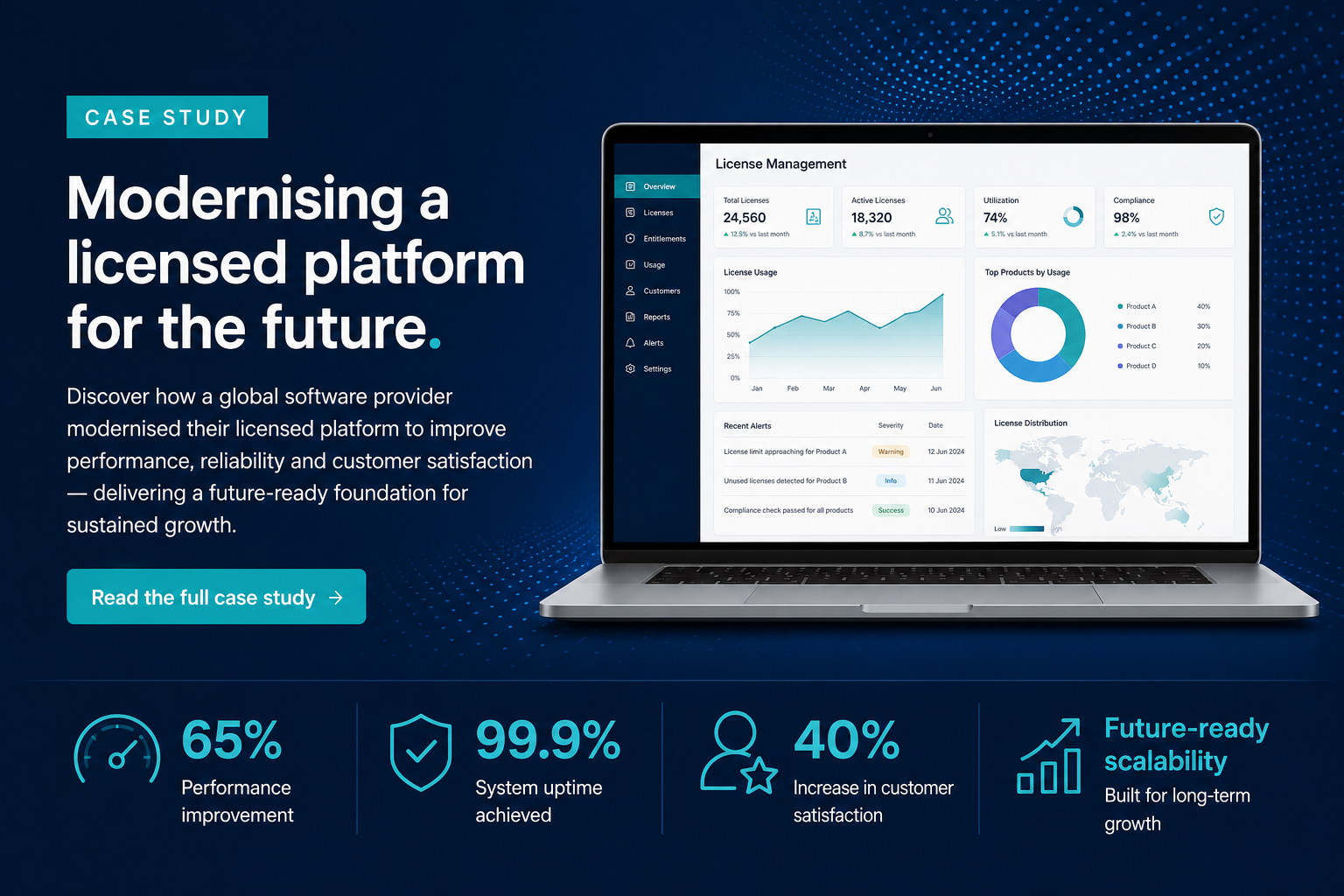
Overview
A leading global insurance and benefits provider was operating a mission‑critical workflow application on a licensed enterprise platform. Over time, rising license costs, rigid release cycles, and limited customisation began to restrict innovation and increase operational expenses.
To address these challenges, the organisation partnered with our team to modernise the application into a fully owned, cloud‑ready, full‑stack solution — maintaining the robustness of existing business processes while gaining full control of cost, architecture, and development agility.
The Challenge
The client's application had evolved over many years into a highly customised system at the heart of their daily operations. While reliable, it presented several growing challenges:
- Escalating license and hosting costs due to platform dependency.
- Restricted flexibility tied to vendor‑controlled release cycles and roadmap priorities.
- Complex upgrade processes that risked business continuity.
- Limited integration with modern analytics, cloud, and identity management systems.
Leadership sought to preserve proven workflows and data models while freeing the business from commercial and technical lock‑in.
Goals and Success Metrics
Together, the project team defined clear objectives:
- Eliminate recurring license and infrastructure costs.
- Preserve or enhance all core workflows and user journeys.
- Establish a clean, modular architecture designed for long‑term evolution.
- Improve system speed, usability, and maintainability.
- Enable seamless integration with existing APIs, data warehouses, and identity systems.
Project success was measured through reduced operational costs, improved user satisfaction, and faster delivery cycles for new features post‑migration.
Our Approach
1. Assessment and Strategy
The engagement began with an in‑depth discovery phase designed to build a complete understanding of the existing system:
- Analysed data models, entities, and inter‑system dependencies.
- Mapped key workflows, integrations, and peak‑load scenarios.
- Identified technical and process pain points impacting scalability and UX.
A detailed transformation roadmap was then created, prioritising high‑value features and defining a phased migration plan to minimise business risk.
2. Target Architecture Design
The project team defined a modern, scalable full‑stack architecture based on clear separation of concerns:
- Front end: Responsive, role‑based interface tailored to end‑user workflows.
- Back end: Secure service layer with well‑defined APIs for business logic.
- Data layer: Normalised schema structured for analytics, reporting, and integration.
The architecture was designed using cloud‑agnostic patterns, ensuring deployment flexibility across on‑premises or preferred cloud environments with no vendor lock‑in.
3. Incremental Rebuild and Migration
The new solution was implemented and deployed through an incremental approach:
- Rebuilt and validated workflows in low‑risk, iterative phases.
- Introduced integration bridges to allow old and new systems to operate in tandem during transition.
- Conducted staged data migrations supported by automated validation and rollback processes.
This approach limited operational disruption and allowed users to adapt progressively.
4. Testing, Validation, and Change Management
End‑user adoption and reliability were central to the rollout's success:
- Users participated in iterative demos and usability reviews.
- Automated and manual testing verified workflow accuracy and performance.
- Targeted training and quick‑reference materials prepared users for the updated interface.
- A structured hyper‑care phase ensured prompt resolution of post‑go‑live issues.
Outcomes
Within the first operational year, the organisation achieved tangible gains:
- License independence: Eliminated recurring platform and hosting costs.
- Greater agility: New functionality could be released without vendor dependencies.
- Performance uplift: Faster load times, streamlined workflows, and simplified UX.
- Improved integration: Native connectivity to analytics platforms, APIs, and identity solutions.
- Future‑ready platform: Built on open standards to support ongoing scalability and internal development.
Why This Approach Works
This project illustrates how enterprises can preserve the value of existing business logic while modernising for agility and independence. By combining deep system analysis with a pragmatic, phased migration strategy, it is possible to:
- Protect past investments in processes and data.
- Reduce recurring operational costs.
- Regain architectural and technological freedom.
- Lay the foundation for continuous improvement and innovation.
For organisations constrained by platform limitations, this approach provides a roadmap to sustainable modernisation — balancing continuity with growth.
Ready to Achieve Similar Results?
Let's discuss how we can help your organisation modernise systems, reduce costs, and improve efficiency.