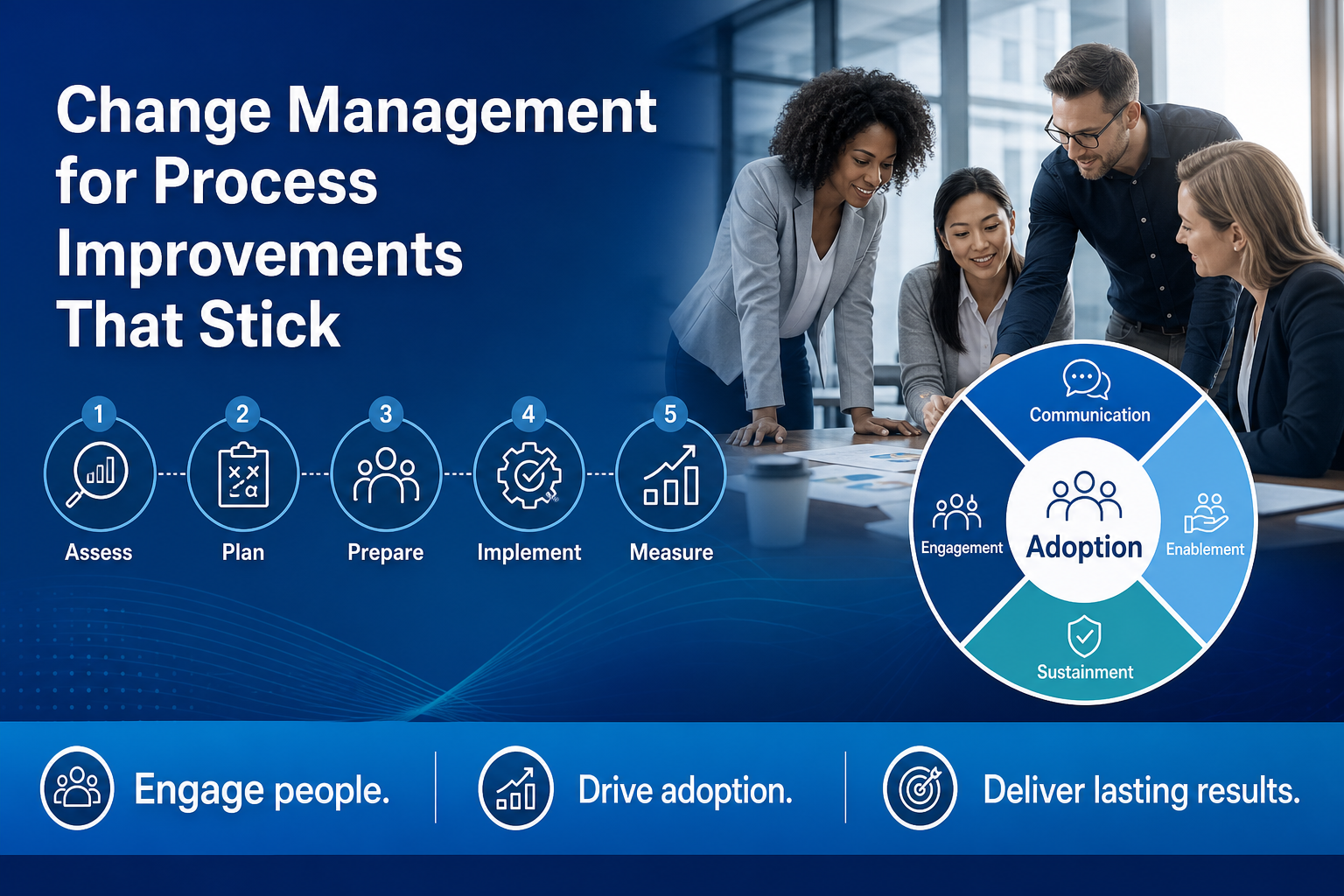
Organisations invest heavily in process redesign, new systems, and automation — then wonder why nothing really changed. The answer is almost always the same: the technical solution was delivered, but the human transition was treated as an afterthought. A training session and an email announcement are not change management.
This article outlines a practical approach to change management for process improvements — one suited to SMEs and mid-market organisations without dedicated change teams. For end-to-end support, see our business process optimisation service.
Why process improvements fail to stick
Research consistently shows that a significant proportion of change initiatives fail to achieve sustained adoption. In process improvement specifically, common causes include:
- Design without input — new processes imposed by consultants or leadership without front-line involvement
- Unclear rationale — staff do not understand why the change matters or what problem it solves
- Loss of autonomy — changes feel like surveillance or micromanagement rather than empowerment
- Increased short-term effort — the new process is harder during the learning curve, and no grace period is allowed
- Competing priorities — day job pressure overrides adoption of the new workflow
- Old tools still available — the legacy spreadsheet, email template, or workaround remains accessible, so people drift back
- No reinforcement — after launch week, nobody checks whether the new process is actually being followed
Recognising these patterns early allows you to design countermeasures into the improvement programme from the start.
Start with the people who do the work
Effective change management begins before the new process is finalised. Involve the people who perform the work at three stages:
- Discovery — ask front-line staff what frustrates them about the current process. Their pain points become the improvement rationale they will later advocate for.
- Co-design — include representatives from each affected role in redesign workshops. They catch practical issues that process analysts miss and become natural champions.
- Pilot feedback — run the new process with a small group before full rollout. Their feedback shapes refinements and generates credible testimonials for wider adoption.
Participation builds ownership. People support what they help create — not what is done to them.
Build a clear case for change
Every affected team needs a concise answer to "why are we doing this?" Frame the case in terms that matter to them:
- For operational staff — less rework, fewer chasing emails, clearer handoffs, reduced overtime during peak periods
- For team leaders — predictable throughput, fewer escalations, better visibility of bottlenecks
- For senior leadership — cost reduction, compliance assurance, customer satisfaction improvement, scalability
Avoid abstract language like "digital transformation" or "operational excellence." Use specific before-and-after scenarios: "Today, approval requests sit in inboxes for an average of four days. The new process targets same-day turnaround with automated routing."
Identify and empower change champions
Every successful process change has informal leaders who influence their peers more effectively than any management directive. Identify them deliberately:
- Look for respected, experienced staff — not necessarily the most senior
- Give champions early access to training and the pilot programme
- Equip them with FAQs, troubleshooting guides, and a direct line to the project team
- Recognise their contribution publicly — in team meetings, all-hands updates, or internal communications
- Protect their time — champions need capacity to support colleagues during transition, not just add change duties to an already full workload
One effective champion per team of eight to twelve people is a practical ratio for most organisations.
Plan the transition, not just the launch
Launch day is the midpoint of change management, not the end. A structured transition plan covers:
- Phased rollout — start with one team or location, refine, then expand. Big-bang launches amplify risk.
- Parallel running — operate old and new processes simultaneously for one full business cycle to validate outputs and build confidence
- Training by role — generic training wastes time. Each role needs instruction on their specific steps, decisions, and system interactions
- Hypercare period — dedicate project team availability for two to four weeks post-launch to resolve issues quickly and visibly
- Retire the old way — archive legacy templates, disable old system paths, and remove workarounds. If the old process remains easy, adoption will be partial
- Communication cadence — weekly updates during transition, then fortnightly check-ins for the first quarter. Silence after launch signals the change no longer matters
Measure adoption, not just outcomes
Process metrics tell you whether the improvement is working. Adoption metrics tell you whether people are actually following the new process:
- Percentage of transactions processed through the new workflow vs legacy workarounds
- Time to proficiency — how quickly new staff reach expected performance on the new process
- Champion feedback on common questions and resistance points
- Informal pulse checks — short surveys or team stand-up questions about what's working and what isn't
Low adoption with good outcomes usually means people found a shortcut that works but is not scalable. High adoption with poor outcomes means the process design needs refinement. Track both.
Handling resistance constructively
Resistance is information, not defiance. When staff push back, investigate the underlying concern:
- "It's slower" — often true during learning. Acknowledge the curve and provide extra support, but set a clear expectation for when proficiency should return
- "The old way worked fine" — explore whether they see the systemic problems the change addresses, or whether the improvement doesn't solve their specific pain point
- "Nobody asked us" — a legitimate complaint if co-design was skipped. Pause, gather input, and adjust where practical
- "This won't last" — reference past failed initiatives honestly, and explain what is different this time (leadership commitment, measurement, resource allocation)
Address resistance with curiosity and adjustment where warranted. Overrule only when the concern is individual preference against a collectively agreed improvement.
Conclusion
Process improvements stick when organisations invest as much in the human transition as in the technical redesign. Involve front-line staff from discovery through pilot, build a clear and specific case for change, empower champions, plan beyond launch day, measure adoption alongside outcomes, and treat resistance as feedback. Change management is not a separate workstream — it is the difference between a process that exists on paper and one that actually runs the business.
Want improvements that last?
We design process changes with adoption built in — from co-design workshops to champion programmes and sustained measurement.