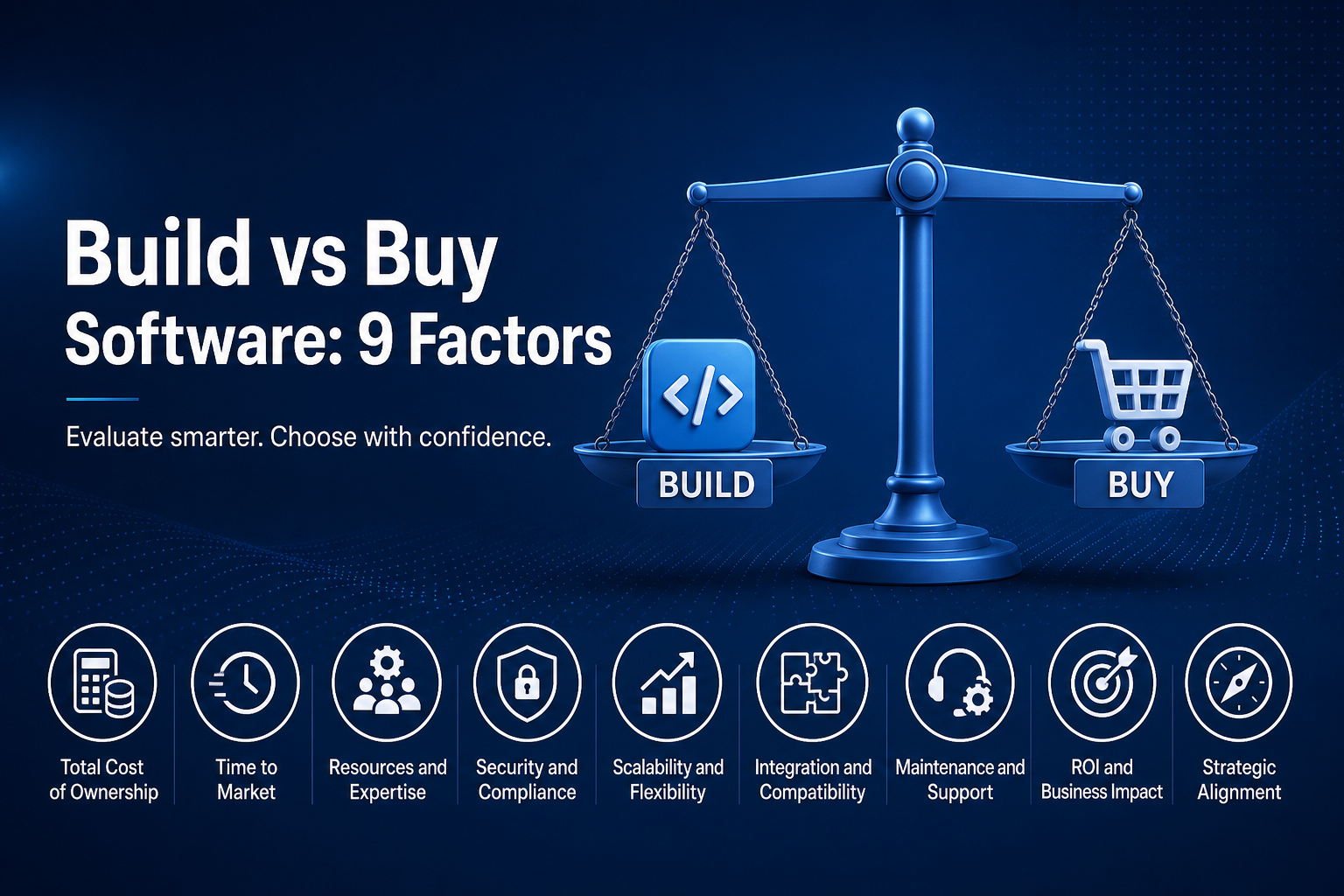
To decide well, you need a practical build vs buy decision framework, not just gut feel. This article walks through nine build vs buy software factors a technical leader should consider, with examples and a simple scoring approach you can adapt for your organisation.
1. Start with the strategic importance
The first question is not “How much will it cost?” but “How critical is this to our competitive advantage?” As a rule of thumb, you should build what differentiates you and buy what does not.
Ask:
- Does this system materially shape our value proposition or customer experience?
- Is there unique IP, algorithmic logic, or workflow that competitors cannot easily copy?
- Would we hesitate to share details of this system publicly?
If the answers are mostly “yes,” strongly bias toward building — or at least owning the core engine and buying supporting components around it. For generic capabilities — email delivery, HR, finance, issue tracking — off-the-shelf or SaaS tools are usually the rational choice.
2. Total cost of ownership over 3–5 years
When weighing custom software vs off the shelf options, comparing sticker prices is misleading; you need to look at total cost of ownership (TCO) over a realistic horizon.
Include, for each option:
- Discovery and product work — time from PMs, architects, and stakeholders
- Build or implementation — engineering, QA, DevOps, vendor professional services
- Infrastructure — hosting, data storage, observability, backups
- Licences and subscriptions — per-seat, usage-based fees, add-ons
- Support and operations — on-call, incident response, user support
- Enhancements — roadmap features, refactors, tech debt repayments
- Replacement or exit — migration off a vendor or from v1 to v2
Studies consistently show that custom builds often overrun initial budgets and timelines, especially without strong product and delivery practices. However, subscription tools can also become expensive at scale, particularly where pricing is usage-based or per-seat.
A simple approach: model both options over 3 and 5 years, then compare not just cost but cost per unit of measurable value — such as incremental revenue, NPS improvement, or operational savings.
3. Time to value and urgency
Time to value is often the decisive factor in build vs buy decisions. If you need something live in weeks, a mature SaaS product will almost always beat a custom build.
Consider:
- Hard deadlines — regulatory dates, customer commitments, seasonal spikes
- Your team’s current load — competing roadmap items and tech debt
- Learning loop speed — how quickly you need real user feedback
Sometimes the best move is to buy a tool to unblock the business, learn from it, and then selectively build a replacement for the truly differentiating pieces later. This “buy now, build later” strategy can de-risk both product-market fit and technical choices.
4. Internal capability and capacity
Building software is not a one-off project; it is a long-term commitment to product management, engineering, security, and operations. Before deciding to build, assess your capability and capacity honestly.
Key questions:
- Do we have the right skills in-house for the required stack and domain?
- Can we commit stable product and engineering ownership for 3+ years?
- Are we ready to run 24/7 operations, monitoring, and incident response?
- Will this project crowd out higher-impact roadmap items?
If your team is lean, overstretched, or lacks certain specialisms (for example, advanced payments, anti-fraud, or real-time comms), it may be safer to buy and integrate. Conversely, if you already have a strong platform team and modern delivery practices, building may be both feasible and strategically smart.
5. Fit, flexibility, and customisation risk
Off-the-shelf tools trade flexibility for speed: they support the most common patterns in your domain, not your quirks. Custom software gives you maximum flexibility, but you then own every decision about UX, data model, and extensibility.
When evaluating a product, look at:
- Functional fit — out-of-the-box support for your must-have use cases
- Configurability — what you can change with settings, not code
- Extensibility — plugin systems, hooks, app frameworks
- Customisation limits — what breaks upgrades or isn’t supported
Deep, code-level customisations to a bought product can create a “worst of both worlds” outcome: you pay vendor pricing yet still own messy bespoke code and upgrade pain. In those cases, a targeted custom build or a more extensible platform may be better.
6. Integration and data strategy
For scale-ups, the build vs buy question is often really an integration question. A decent product that plugs cleanly into your stack can beat a “perfect” product that is an integration nightmare.
Evaluate both options on:
- API quality — REST/GraphQL standards, documentation, rate limits, SDKs
- Eventing — webhooks, streaming, or CDC support for near real-time flows
- Identity — SSO, SCIM, RBAC models that align with your org
- Data access — export capabilities, warehouse connectors, reverse ETL
- Existing ecosystem — prebuilt integrations with your CRM, billing, data tools
Where integrations are complex and domain-specific, building can give you tighter control and reduce brittle couplings. But if a vendor already offers proven integrations for your core systems, that should strongly influence your choice.
7. Vendor and roadmap risk (if you buy)
Buying does not eliminate risk; it reshapes it. Instead of delivery risk in your team, you take on vendor risk and roadmap alignment risk.
Investigate:
- Vendor stability — funding, profitability, customer base, churn signals
- Roadmap fit — whether their 12–24 month roadmap aligns with your direction
- SLAs and support — uptime guarantees, response times, escalation paths
- Data ownership — export guarantees, lock-in mechanisms, IP clauses
- References — similar customers in your size and industry
If your use case is niche and you represent a small share of the vendor’s revenue, roadmap risk is higher; they may not prioritise what you need. In those situations, buying a more extensible platform or building a focused component can reduce dependence on a single roadmap you do not control.
8. Compliance, security, and governance
Regulated industries, strict data residency requirements, or strong customer security expectations can tilt the build vs buy decision either way.
Consider:
- Certifications — SOC 2, ISO 27001, PCI DSS, HIPAA, GDPR alignment
- Data residency and sovereignty — where data is stored and processed
- Access controls — fine-grained permissions, audit trails, admin controls
- Security operations — vulnerability management, patching cadence
Mature SaaS vendors often have stronger security posture and more certifications than a small internal team can realistically achieve. But if you have very specific regulatory constraints or need unusual controls, a custom build or self-hosted product may be necessary.
9. A practical scoring framework for build vs buy
To make the decision explicit and repeatable, you can use a simple scoring model. Weight each factor based on importance to your context, then score build and buy options from 1 (poor) to 5 (excellent).
| Factor | Weight (1–5) | Build (1–5) | Buy (1–5) |
|---|---|---|---|
| Strategic differentiation | 5 | 5 | 2 |
| Time to value | 4 | 2 | 5 |
| TCO (3–5 years) | 4 | 3 | 4 |
| Internal capability | 3 | 4 | 3 |
| Fit & flexibility | 4 | 5 | 3 |
| Integration complexity | 3 | 3 | 4 |
| Vendor/roadmap risk | 3 | 4 | 2 |
| Compliance & security | 3 | 3 | 4 |
| Weighted total | 29 | 107 | 97 |
Multiply each score by its weight, sum the totals for build and buy, and use this as input to the decision — not as a substitute for judgement. The key value is in forcing the conversation about trade-offs instead of relying on the loudest voice in the room.
Pros and cons summary
| Aspect | Custom build | Buy / SaaS |
|---|---|---|
| Differentiation | High potential if core to your product | Limited; same as competitors |
| Time to value | Slower initial launch | Faster initial deployment |
| Up-front cost | Higher discovery and build cost | Lower build cost, but licence fees |
| Long-term TCO | Can be lower at scale if well-designed | Can escalate with usage/seat growth |
| Flexibility | Maximum control and customisation | Limited to vendor roadmap |
| Integration | Tailored to your stack | Depends on vendor APIs and ecosystem |
| Risk profile | Delivery and tech risk in-house | Vendor, roadmap, and lock-in risk |
Conclusion: when to build software vs buy
For most scale-ups, the practical rule is: build the systems that are closest to your core value proposition and where you need real differentiation; buy everything else, and integrate it well. Revisit that decision as you grow, because shifts in your strategy, capabilities, and the market can change the right answer over time.
Weighing build vs buy on your roadmap?
We help technical leaders assess options, model TCO, and deliver custom software or integrations when building is the right call.